Help shape Safeguarding in our diocese: survivor views and representation sought
Please note: This information is primarily intended for victims and survivors of abuse. Help us protect…
Read the story
Good morning, Synod, it is good to see you all. Thank you for being here. Thank you, also, Archdeacon Eleanor, for grounding our meeting in Scripture, reflection and prayer.
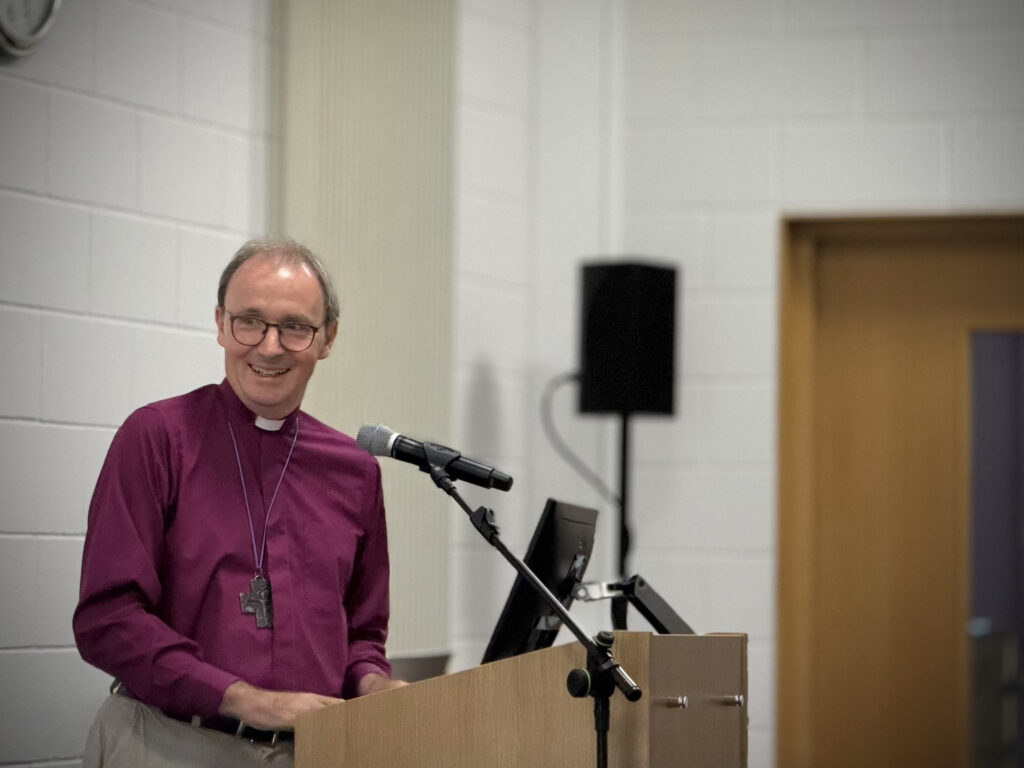
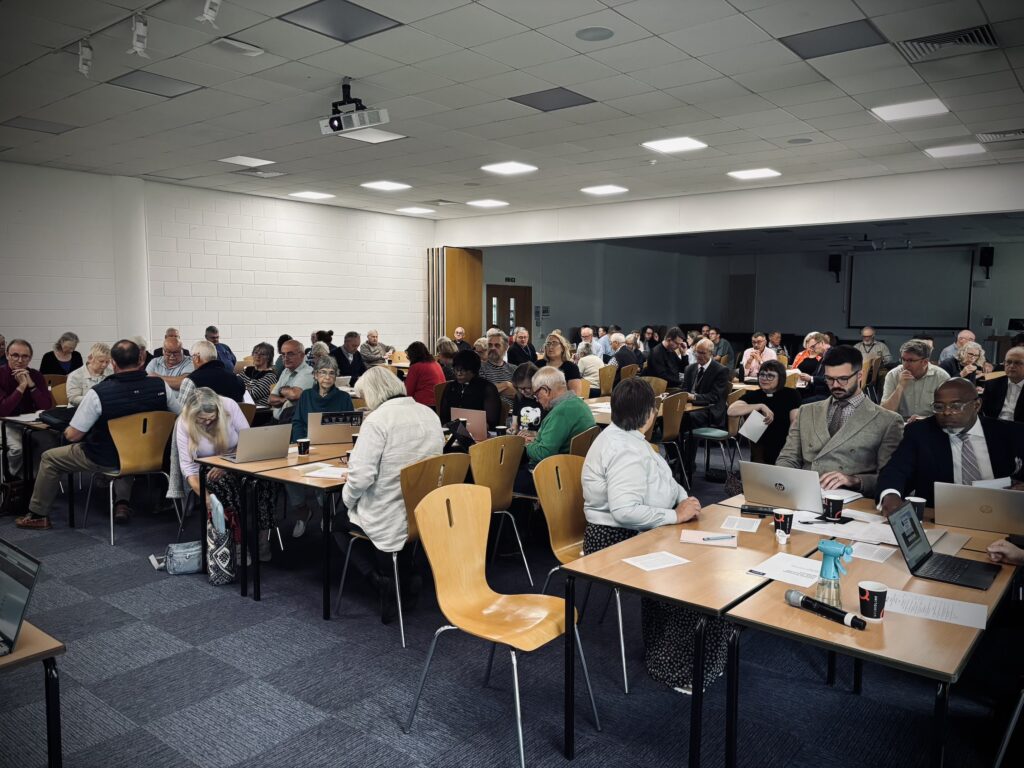
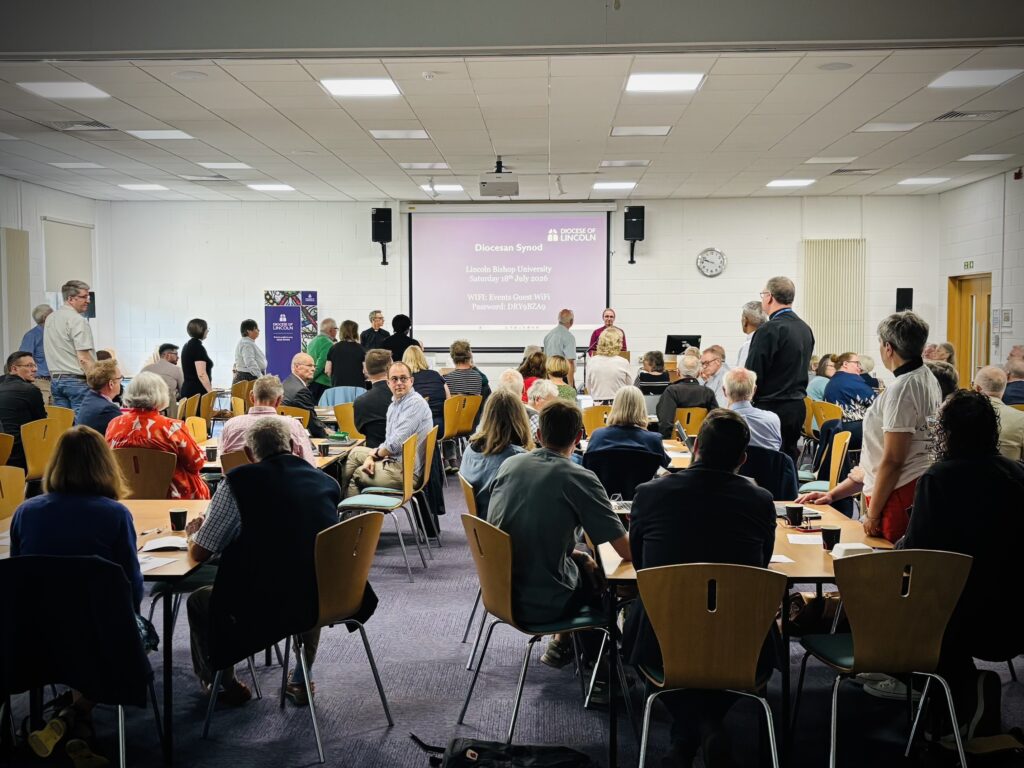
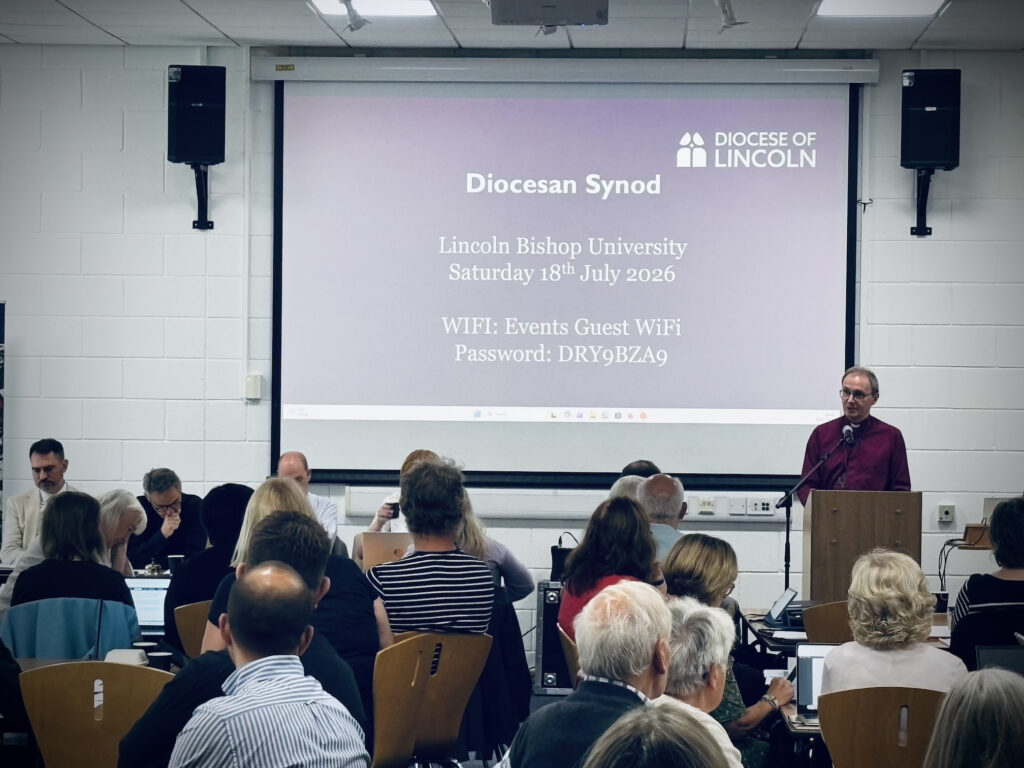
In some ways our Agenda today matches elements of the Annual Parish Meetings that many of us will have participated in over recent weeks. This is very clear in the first item after Questions which is, indeed, the Annual Meeting of the Lincoln Diocesan Trust and Board of Finance. All members of Diocesan Synod are members of the Board. The Bishop’s Council has Trustee responsibilities, similar to those held by elected members of Parochial Church Councils, and in that sense we are accountable to you. Would those members of Bishops’ Council who are present please stand? – Thank you for your service.
But all members of Diocesan Synod, I suggest, are yourselves accountable to your congregations for the wider work of the Trust. It really isn’t ‘us and them’, it’s ‘us’ and ‘us’.
The Diocesan Trust is one of the things that makes us who we are as a diocese. It enables us by providing staff and services, by being part of the connective tissue that holds our shared body together. Like the staff of any organisation, the staff of the Diocesan Board of Finance and the Parish Support Office can get things wrong, but I know how hard Andrew and his team work, and I know that their prime objective is to serve the local church in all its myriad different localities across the whole of Greater Lincolnshire. Other dioceses are quite envious of the resources that we have, financial and human, and that are expressed in the Report that has been shared with you. Do, please, ask appropriate questions and engage with the work that is celebrated in this Annual Report, and note that I do say ‘celebrate’ – we have a great deal to be thankful to God for that is set out in this Report.
Then, secondly, later in the meeting we will receive the Annual Report of the Diocesan Board of Education. The Board of Education is, itself, a separate Trust, legally constituted to support the extraordinary and vital work of our Church Schools. The Diocesan Board of Finance does make a grant to the Board of Education, with respect to the work of Canon Paul Thompson, our Director of Education, so we receive the DBE’s Report with interest. But most of us here are not as directly responsible for the DBE as its own Board of Trustees. Might I please ask any Trustees of the DBE who are present also to stand? Thank you for all you do, and for the staff of the DBE.
Then, as in any Annual Parochial Church Meeting, a section of our agenda today is devoted to the work of safeguarding. Jack Redeyoff, our Diocesan Safeguarding Officer, will report to us and we will have opportunity to reflect on the considerable load that the Safeguarding Team is carrying at the moment.
Finally, our last item is to approve the Trustee election schedule that is part of our Governance Review. The Review itself is the fruit of the external audit that the Bishop’s Council commissioned, grounded in the desire to be as accountable, efficient and effective a Trustee body as it is possible to be. The particular item for approval relates to our transition from three archdeaconries to two.
So much of our agenda is about accountability.
But alongside the parts of today’s Agenda that express our legal and governance responsibilities and accountabilities, there are other items that relate to different aspects of our shared life. Andrew and I will provide you with an update on the work that is proceeding on our Diocesan Strategy. As some may already know, we recently received the good news that the Diocese of Lincoln has been awarded some grant funding from the Church Commissioners to support our strategy development. We sought funding for three things: a time-limited post to continue our work with Key Mission churches, church plants and church renewal and revitalisation; a post to help us to analyse the huge amounts of data that are required for major funding bids; and also support with the development of the rural strand of our strategy, which will be a major component going forward. This grant, alongside the £1.2 million pounds that the Diocese of Lincoln receives annually from the Church Commissioners to support mission and ministry in our Lowest Income Communities, demonstrates the commitment that the whole body of Christ in England makes to us in Lincoln.
Many dioceses receive no Lowest Income Community funding. It is obviously just that this money is directed to those parts of the country that are poor, and we have some very poor communities in Greater Lincolnshire, but I don’t think we should expect this funding – it is given as an expression of mutuality – of the body as a whole recognising its need as a whole body to support all of its members and organs. This is Paul’s theology in practice, and as a diocese we are beneficiaries.
Our agenda helps us to look forward.
Which finally brings me to the presentation that Colin Tomlin will be making. I haven’t been given any sneak preview about what he may actually say, but along with all other members of Synod I have had opportunity to look at the papers in our pack. Therefore, what I say now is based on those papers, isn’t intended to pre-empt and I apologise if I inadvertently do so.
But to set Colin’s report in context, I thought it might be helpful to Synod to give you an update on the work that is being done to make clergy appointments. There are currently 85 stipendiary incumbents in post in the Diocese of Lincoln. If the appointments processes that are running at the moment are successful, I believe we will reach 94 by the autumn. The appointments are being made in accordance with the deployment plans that were discerned locally in LMPs over the last few years, apart from in those places where the plans have been locally revised. So we are approaching the approximately 100 posts that were envisaged when we embarked on Resourcing Sustainable Cburch/A Time to Change Together. I know that the agreed deployment means that there are fewer priests in post than most of us would want, and that some parts of the diocese have seen quite a significant reduction in clergy numbers. I also know that arrangements for oversight in some parishes and benefices are still coming together, and I fully understand the frustrations involved. But in terms of recruitment, we are being successful in raising our numbers, and in gradually drawing people to Lincoln. This is good news! This is not happening universally across the Church of England. People sense that good things are happening in Lincolnshire!
But as revealed in the report of pledges made, however, the picture is not so good. There is a decline, both in pledges and in payment. We were alerted to this in our last Diocesan Synod and, again, I understand the complexity of the financial situation which is being faced in many places, and the obvious impact of rising utility and food prices. It was put quite clearly in our last meeting: maintain the church building or pay for the priest? I have reflected a lot on that last Synod, both in preparation for today and as I have travelled the diocese in the weeks since. And sometimes, of course, a solution is proposed that is effectively: ‘someone else should pay for the priest’ – usually London or Lincoln.
Well, I’ve already said today that London does contribute quite a lot to the cost of our clergy, as, in a different way, does the Diocesan Trust in Lincoln. And we will indeed be putting in further bids for financial support to the Church Commissioners. But my personal view is that the answers to our problem do not lie wholly with them. Rather, I need to look back at myself, and at each other, and to invite you, as Synod members, to take a clear message back to the parishes, which is that we need to make our pledges, indeed to increase them, or we will not be able to appoint the number of clergy that we have collectively agreed, whose task is to help to sustain the life of the diocesan body. Please don’t let us roll backwards, when we have come so far together.
I was saying to a group of colleagues a while ago that I have had to renew my attitude to my own giving since coming to the Diocese of Lincoln. As a parish priest before, I knew where my money went, and I knew what my parishes contributed to the body as a whole. I’ve served in different parishes. In one, our pledge was about half the nominal ‘cost’ of a priest. In another, our pledge was two and a half times the nominal ‘cost’ and all they had was me, in both cases. But in each of those cases I felt that what I was giving, through the parishes, was supporting the life of the church in the diocese as a whole.
I still feel that now that I am doing that here, though I have had to train myself somewhat differently, as I will describe. I tithe, to the diocese, and this means that every parish I go to, every church I drive past, when I’m there I think: ‘my money is supporting ministry for you’ – whether that is your parish priest, or contributing to the expenses of your retired priest or the local licensed Reader. I’ve learnt to think beyond what I can just see with my eyes as I look at these people, this building – I’ve got to see everyone. All God’s people in the Diocese of Lincoln. And that’s why I give. Because I want us all to flourish. I have to love the person that I can see, and all the people that I can’t see as well. And my hunch is that others are on this journey of renewal with me, for which I rejoice. Because it’s a spiritual journey, as much as a financial one.
Going back to the early days of A Time to Change Together, to Resourcing Sustainable Church, we tried to agree pledges and deployment in local mission partnerships – because there are very few parishes that in Lincolnshire can straightforwardly pledge sufficient for their ‘own’ priest – our parishes need each other. All parts of the diocese need the other parts. We are huge. I know that people think locally and don’t necessarily travel. That is fine. Celebrate the local. I love the village in which I live. But all the locals need their neighbours, they really do. And we can no longer think: ‘that’s up to someone else’. Where is the dignity in that? We need to build the whole. We need to support and help those of us who are struggling, because in time we are all likely to struggle, all to be in need of help. Again, think back to St Paul, and to the Body of Christ, and to our interdependence and radical need of each other. Renew. Re-vision. Rejoice.
This is not the address that I had planned to write when I sat down earlier this week. I’ll let you guess what I might have thought I’d talk about – and it wasn’t football. But I felt as Saturday drew closer that the Synod Agenda was shaping what I needed to say. Obviously I’ve rooted these words in our passage for Dwelling in the Word – which I didn’t choose and which I didn’t know had been chosen until Wednesday. – But I would like to finish by pointing to another piece of Scripture – Luke 18.10-13 ‘Two men went up to the temple to pray, one a Pharisee and the other a tax-collector. The Pharisee, standing by himself, was praying thus, “God, I thank you that I am not like other people: thieves, rogues, adulterers, or even like this tax-collector. I fast twice a week; I give a tenth of all my income.” But the tax-collector, standing far off, would not even look up to heaven, but was beating his breast and saying, “God, be merciful to me, a sinner!”’
In sharing with you something of my own thoughts about money this morning, I run the risk that the Pharisee runs in Jesus’ teaching, I know that. But in being personal, I am actually trying to say that I give because I want to give, and I give because of God. He is the reason. If we are thinking about our parish pledges, our personal pledges, it is the reason for making them that matters, just as much as the amount. And we make any pledge not so that we look good, but so that God is honoured and the work of his Church enabled. Let us not look over our shoulders at our neighbours in the Diocese of Lincoln and calculate our generosity in some kind of relationship to what we perceive to be theirs. Rather, let us look to God, and see those who are alongside us, including those who live distant from us or who appear to be different from us, as our neighbours, given to us by God to love.
Please note: This information is primarily intended for victims and survivors of abuse. Help us protect…
Read the storyDiscover how you can join the Church Repair Society Committee, as well as volunteer to support the Secretary and Treasurer functions.
Read the storyThe Revd Canon Christine Goldsmith died on Thursday 30 July 2026. Read about her faithful service and find details of the funeral arrangements here.
Read the story